I Am a Born Again Son of Father God

God the Begetter is a title given to God in various religions, most prominently in Christianity. In mainstream trinitarian Christianity, God the Father is regarded as the start person of the Trinity, followed by the 2d person, God the Son Jesus Christ, and the third person, God the Holy Spirit.[1] Since the 2d century, Christian creeds included affirmation of belief in "God the Father (Omnipotent)", primarily in his capacity every bit "Begetter and creator of the universe".[2]
However, in Christianity the concept of God as the male parent of Jesus Christ goes metaphysically further than the concept of God equally the creator and male parent of all people,[3] every bit indicated in the Apostles' Creed where the expression of belief in the "Father almighty, creator of sky and earth" is immediately, merely separately followed past in "Jesus Christ, his only Son, our Lord", thus expressing both senses of fatherhood.[four]
Christianity

A figurative drawing of God, in the old German prayer books (Waldburg-Gebetbuch), about 1486
Overview

In much of modern Christianity, God is addressed as the Father, in part because of his agile interest in human affairs, in the way that a father would accept an interest in his children who are dependent on him and equally a begetter, he will reply to humanity, his children, acting in their best interests.[five] [vi] [seven] [eight] Many believe they can communicate with God and come closer to him through prayer – a key element of achieving communion with God.[9] [x] [11] [12]
In full general, the title Father (capitalized) signifies God'southward function as the life-giver, the authorization, and powerful protector, often viewed as immense, almighty, all-seeing, omnipresent with infinite ability and charity that goes beyond human understanding.[13] For instance, afterwards completing his monumental work Summa Theologica, Catholic St. Thomas Aquinas concluded that he had non yet begun to understand 'God the Begetter'.[14] Although the term "Father" implies masculine characteristics, God is usually defined as having the form of a spirit without any man biological gender, e.g. the Catechism of the Catholic Church No. 239 specifically states that "God is neither human nor woman: he is God".[15] [sixteen] Although God is never directly addressed as "Female parent", at times motherly attributes may be interpreted in Old Testament references such as Isa 42:fourteen, Isa 49:14–fifteen or Isa 66:12–13.[17]
In the New Testament, the Christian concept of God the Father may be seen as a continuation of the Jewish concept, but with specific additions and changes, which over time fabricated the Christian concept become fifty-fifty more than singled-out by the start of the Heart Ages.[xviii] [19] [20] The conformity to the Erstwhile Testament concepts is shown in Matthew 4:10 and Luke four:8 where in response to temptation Jesus quotes Deuteronomy 6:13 and states: "Information technology is written, y'all shall worship the Lord your God, and him but shall y'all serve."[18] one Corinthians 8:half-dozen shows the distinct Christian teaching nearly the agency of Christ by get-go stating: "there is one God, the Father, of whom are all things, and we unto him" and immediately continuing with "and one Lord, Jesus Christ, through whom are all things, and we through him."[nineteen] This passage clearly acknowledges the Jewish teachings on the uniqueness of God, all the same also states the role of Jesus as an agent in creation.[19] Over time, the Christian doctrine began to fully diverge from Judaism through the teachings of the Church building Fathers in the second century and past the fourth century conventionalities in the Trinity was formalized.[xix] [20] According to Mary Rose D'Angelo and James Barr, the Aramaic term Abba was in the early on times of the New Testament neither markedly a term of endearment,[21] [22] [23] nor a formal word; but the word normally used by sons and daughters, throughout their lives, in the family context.[24]
Old Attestation
According to Marianne Thompson, in the Old Testament, God is chosen "Begetter" with a unique sense of familiarity. In addition to the sense in which God is "Father" to all men considering he created the globe (and in that sense "fathered" the world), the same God is besides uniquely the law-giver to his chosen people. He maintains a special, covenantal begetter-child human relationship with the people, giving them the Shabbat, stewardship of his prophecies, and a unique heritage in the things of God, calling Israel "my son" considering he delivered the descendants of Jacob out of slavery in Egypt [Hosea eleven:ane] according to his covenants and oaths to their fathers, Abraham, Isaac and Jacob. In the Hebrew Bible, Isaiah 63:16 (JP) reads: "For Y'all are our father, for Abraham did not know us, neither did Israel recognize us; Yous, O [YHWH], are our father; our redeemer of old is your name." To God, according to Judaism, is attributed the fatherly function of protector. He is titled the Father of the poor, of the orphan and the widow, their guarantor of justice. He is also titled the Father of the rex, every bit the teacher and helper over the judge of Israel.[25]
Co-ordinate to Alon Goshen-Gottstein, in the Old Testament "Father" is mostly a metaphor; it is non a proper name for God merely rather i of many titles by which Jews speak of and to God. Co-ordinate to Mark Sameth, references to God the Begetter convulsing in labor, giving nativity, and suckling (Deuteronomy 32:13, 18) hint to a priestly belief, noted in the sixteenth and nineteenth centuries by Guillaume Postel and Michelangelo Lanci respectively, that "God the Father" is a dual-gendered deity. [26] [27] [28] [29] In Christianity fatherhood is taken in a more literal and noun sense, and is explicit well-nigh the need for the Son as a ways of accessing the Father, making for a more metaphysical rather than metaphorical interpretation.[3]
New Testament
At that place is a deep sense in which Christians believe that they are fabricated participants in the eternal relationship of Father and Son, through Jesus Christ. Christians phone call themselves adopted children of God:[30] [31]
But when the fullness of time had come, God sent forth his Son, born of adult female, born under the police force, to redeem those who were under the constabulary, so that we might receive adoption as sons. And because you are sons, God has sent the Spirit of his Son into our hearts, crying, "Abba! Father!" So yous are no longer a slave, simply a son, and if a son, then an heir through God.

In Christianity the concept of God as the Father of Jesus is distinct from the concept of God as the creator and Male parent of all people, as indicated in the Apostles' Creed.[4] The profession in the creed begins with expressing conventionalities in the "Begetter omnipotent, creator of heaven and world" and then immediately, but separately, in "Jesus Christ, his only Son, our Lord", thus expressing both senses of fatherhood inside the creed.[4]
History
Since the second century, creeds in the Western Church have included affirmation of belief in "God the Father (Omnipotent)", the primary reference being to "God in his capacity as Father and creator of the universe".[2] This did not exclude either the fact the "eternal begetter of the universe was also the Father of Jesus the Christ" or that he had fifty-fifty "vouchsafed to adopt [the laic] every bit his son by grace".[two]
Creeds in the Eastern Church (known to have come up from a later appointment) began with an affirmation of faith in "i God" and almost always expanded this by adding "the Begetter Omnipotent, Maker of all things visible and invisible" or words to that issue.[2]
By the end of the first century, Clement of Rome had repeatedly referred to the Father, Son and Holy Spirit, and linked the Father to creation, 1 Clement 19.2 stating: "let us wait steadfastly to the Male parent and Creator of the universe".[32] Effectually Advertizement 213 in Adversus Praxeas (chapter 3) Tertullian is believed to take provided a formal representation of the concept of the Trinity, i.e. that God exists as ane "substance" merely three "Persons": The Begetter, the Son and the Holy Spirit, and with God the Father being the Caput.[33] [34] Tertullian as well discussed how the Holy Spirit proceeds from the Father and the Son.[33] While the expression "from the Begetter through the Son" is also establish amidst them.[35] [36] [37]
The Nicene Creed, which dates to 325, states that the Son (Jesus Christ) is "born of the Begetter before all ages", indicating that their divine Begetter-Son relationship is seen as not tied to an outcome within time or human being history.
Trinitarianism

To Trinitarian Christians (which include Roman Catholics, Eastern Orthodox, Oriental Orthodox, Anglicans, and well-nigh merely not all Protestant denominations), God the Father is not a separate God from God the Son (of whom Jesus is the incarnation) and the Holy Spirit, the other hypostases of the Christian Godhead.[38] [39] [40] In Eastern Orthodox theology, God the Male parent is the arche or principium ("beginning"), the "source" or "origin" of both the Son and the Holy Spirit, and is considered the eternal source of the Godhead.[41] The Begetter is the one who eternally begets the Son, and the Father through the Son eternally breathes the Holy Spirit.[32] [41]
As a member of the Trinity, God the Begetter is one with, co-equal to, co-eternal, and agnate with the Son and the Holy Spirit, each Person being the ane eternal God and in no way separated: all alike are uncreated and omnipotent.[32] Considering of this, the Trinity is beyond reason and can merely be known by revelation.[39] [42]
The Trinitarian concept of God the Father is not pantheistic in that he is non viewed as identical to the universe or a vague notion that persists in it, only exists fully outside of cosmos, equally its creator.[38] [43] He is viewed as a loving and caring God, a Heavenly Father who is agile both in the earth and in people's lives.[38] [43] He created all things visible and invisible in dearest and wisdom, and created man for his own sake.[43] [44]
The emergence of Trinitarian theology of God the Father in early on Christianity was based on two key ideas: offset the shared identity of the Yahweh of the One-time Testament and the God of Jesus in the New Testament, so the self-distinction and nonetheless the unity between Jesus and his Begetter.[45] [46] An example of the unity of Son and Father is Matthew 11:27: "No one knows the Son except the Father and no one knows the Begetter except the Son", asserting the mutual knowledge of Father and Son.[47]
The concept of fatherhood of God does appear in the Old Testament, but is not a major theme.[45] [48] While the view of God equally the Father is used in the Old Testament, it only became a focus in the New Testament, as Jesus often referred to it.[45] [48] This is manifested in the Lord'southward prayer which combines the earthly needs of daily bread with the reciprocal concept of forgiveness.[48] And Jesus' emphasis on his special relationship with the Father highlights the importance of the distinct yet unified natures of Jesus and the Father, building to the unity of Begetter and Son in the Trinity.[48]
The paternal view of God as the Father extends across Jesus to his disciples, and the unabridged Church, as reflected in the petitions Jesus submitted to the Father for his followers at the cease of the Good day Soapbox, the night before his crucifixion.[49] Instances of this in the Farewell Soapbox are John fourteen:20 as Jesus addresses the disciples: "I am in my Male parent, and y'all in me, and I in you" and in John 17:22 equally he prays to the Father: "I have given them the glory that you gave me, that they may be one equally we are one."[50]
Nontrinitarianism
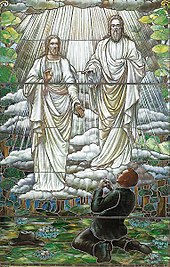
The Church building of Jesus Christ of Latter-day Saints' delineation of God the Father and the Son Jesus
A number of Christian groups reject the doctrine of the Trinity, merely differ from one another in their views regarding God the Father.[51]
In the beliefs and practices of The Church building of Jesus Christ of Latter-day Saints (LDS Church), the well-nigh prominent conception of "the Godhead" is as a divine council of three distinct beings: Elohim (the Male parent), Jehovah (the Son, or Jesus), and the Holy Spirit. The Father and Son are considered to have perfected, physical bodies, while the Holy Spirit has a body of spirit.[52] LDS Church members believe God the Father presides over both the Son and Holy Spirit, where God the Father is greater than both, but they are one in the sense that they have a unity of purpose.[53] [54]
In Jehovah'south Witness theology, only God the Father (Jehovah) is the one truthful almighty God, even over his Son Jesus Christ. They teach that the Word is God'southward Only-begotten Son, and that the Holy Spirit is God'southward agile forcefulness (projected free energy). They believe these two are united in purpose, but are non ane beingness and are not equal in power. While the Witnesses admit Jesus' pre-being, perfection, and unique "Sonship" from God the Father, and believe that Christ had an essential role in creation and redemption, and is the Messiah, they believe that only the Father is without beginning. They say that the Son was the Father's just straight creation, before all ages. God the Father is emphasized in the Jehovah's Witnesses meetings and services more than Christ the Son, as they teach that the Male parent is greater than the Son.[55]
Oneness Pentecostalism teaches that God is a singular spirit who is one person, not three divine persons, individuals or minds. God the Father is the title of the supreme creator. The titles of the Son and Holy Spirit are merely titles reflecting the different personal manifestations of the One True God the Male parent in the universe.[56] [57] [ page needed ]
Other religions
Although similarities exist among religions, the common language and the shared concepts about God and his championship Begetter among the Abrahamic religions is quite limited, and each religion has very specific belief structures and religious classification with respect to the subject.[58] While a religious teacher in one faith may exist able to explicate the concepts to his own audition with ease, significant barriers remain in communicating those concepts across religious boundaries.[58]
Bài Shàngdì Huì
A syncretic sect created by Hong Xiuquan, founder of the Taiping Heavenly Kingdom, that mixed Protestantism and Chinese folk religion, the objective of this sect was to overthrow the Manchus and restore power to the Han. God consisted of a triad made up of Shangdi (the Supreme Emperor in ancient Chinese worship), Christ equally the eldest son and Hong equally the youngest son.
Hinduism
In Hinduism, Bhagavan Krishna in the Bhagavad Gita, affiliate 9, verse 17, stated: "I am the Father of this globe, the Female parent, the Dispenser and the Grandfather", one commentator adding: "God existence the source of the universe and the beings in it, He is held as the Father, the Mother and the Gramps".[59] A genderless Brahman is also considered the creator and Life-giver, and the Shakta goddess is viewed as the divine female parent and life-bearer.[lx] [61]
Islam
Unlike in Judaism, the term "father" is not formally applied to God by Muslims, and the Christian notion of the Trinity is rejected in Islam.[62] [63] Fifty-fifty though traditional Islamic teaching does not formally prohibit using the term "Father" in reference to God, information technology does non propagate or encourage it. At that place are some narratives of the Islamic prophet Muhammad in which he compares the mercy of God toward his worshipers to that of a mother to her infant child.[64]
Islamic education rejects the Christian father-son relationship of God and Jesus, and states that Jesus is a prophet of God, not the Son of God.[62] Islamic theology strictly reiterates the Absolute Oneness of God, and totally separates him from other beings (whether humans, angel or any other holy figure), and rejects any form of dualism or Trinitarianism. Chapter 112 of the Quran states:
Say: He is God, the One and Only; God, the Eternal, Absolute; He begetteth non, nor is He begotten; And there is none like unto Him. (Sura 112:1–iv, Yusuf Ali)
Judaism
In Judaism, the apply of the "Father" title is generally a metaphor, referring to the role as Life-giver and Police-giver, and is 1 of many titles by which Jews speak of and to God.[3] The Jewish concept of God is that God is non-corporeal, transcendent and immanent, the ultimate source of dear,[65] [66] [67] [68] and a metaphorical "Father".[three]
The Aramaic term for father (Hebrew: אבא, abba) appears in traditional Jewish liturgy and Jewish prayers to God (eastward.1000. in the Kaddish).
According to Ariela Pelaia, in a prayer of Rosh Hashanah, Areshet Sfateinu, an ambivalent mental attitude toward God is demonstrated, due to his role as a father and every bit a king. Free translation of the relevant judgement may be: "today every creature is judged, either as sons or as slaves. If equally sons, forgive united states of america like a father forgives his son. If as slaves, we wait, hoping for good, until the verdict, your holy majesty."[ citation needed ] Another famous prayer emphasizing this dichotomy is called Avinu Malkeinu, which means "Our Father Our Male monarch" in Hebrew. Normally the entire congregation volition sing the last verse of this prayer in unison, which says: "Our Father, our Rex, answer us as though we have no deed to plead our cause, salvage us with mercy and loving-kindness."[69]
Sikhism
The Guru Granth consistently refers to the creator as "He" and "Father". This is because the Granth is written in north Indian Indo-Aryan languages (mixture of Punjabi and dialects of Hindi) which have no neutral gender. Since the Granth says that the God is indescribable, God has no gender co-ordinate to Sikhism.[70]
God in the Sikh scriptures has been referred to past several names, picked from Indian and Semitic traditions. He is called in terms of human relations as father, female parent, brother, relation, friend, lover, beloved, husband. Other names, expressive of his supremacy, are thakur, prabhu, svami, sah, patsah, sahib, sain (Lord, Main).[seventy]
In Western art

For about a thousand years, no attempt was made to portray God the Male parent in human course, because early Christians believed that the words of Exodus 33:20 "Grand canst not see my face: for at that place shall no man see Me and live" and of the Gospel of John 1:eighteen: "No man hath seen God at any time" were meant to apply not only to the Begetter, but to all attempts at the depiction of the Father.[71] Typically only a small role of the trunk of Father would be represented, usually the hand, or sometimes the face up, but rarely the whole person, and in many images, the figure of the Son supplants the Male parent, so a smaller portion of the person of the Father is depicted.[72]
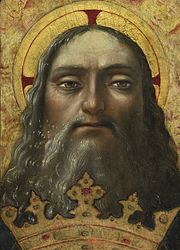
Central Italian School 16th century Head of God the Father
In the early on medieval catamenia God was often represented by Christ as the Logos, which connected to be very common even later the separate figure of God the Father appeared. Western art eventually required some manner to illustrate the presence of the Father, and then through successive representations a ready of artistic styles for the depiction of the Father in human form gradually emerged around the 10th century CE.[71]
By the twelfth century depictions of a figure of God the Male parent, essentially based on the Ancient of Days in the Volume of Daniel had started to appear in French manuscripts and in stained glass church windows in England. In the 14th century the illustrated Naples Bible had a depiction of God the Male parent in the Burning bush-league. By the 15th century, the Rohan Book of Hours included depictions of God the Male parent in human being form or anthropomorphic imagery. The delineation remains rare and often controversial in Eastern Orthodox fine art, and by the time of the Renaissance creative representations of God the Father were freely used in the Western Church.[73]
Run into likewise
- Divine filiation
- Male parent Time
- God Alone
- Eugenia Elisabetta Ravasio
- Sabellianism
- Sky father
References
- ^ Gilles Emery (2011). The Trinity: An Introduction to Catholic Doctrine on the Triune God. Catholic University of America Press. ISBN978-0-8132-1864-9.
- ^ a b c d Kelly, J.N.D. Early Christian Creeds Longmans:1960, pp. 136, 139, 195 respectively
- ^ a b c d "God the Male parent in Rabbinic Judaism and Christianity: Transformed Background or Mutual Footing?, Alon Goshen-Gottstein. The Elijah Interfaith Found, first published in Journal of Ecumenical Studies, 38:4, Spring 2001" (PDF). elijah-interfaith.org. Archived from the original (PDF) on 17 December 2012.
- ^ a b c Robert C. Neville, Symbols of Jesus: a Christology of symbolic engagement, 2002 ISBN 0521003539 p. 26
- ^ Bartolo-Abela, Thou. (2012). The Divine Eye of God the Begetter (2nd ed.). p. 108. ISBN978-0983715290.
- ^ John W. Miller, Calling God "Male parent" (November 1999) ISBN 0809138972 pages x–xii
- ^ Diana L. Eck (2003) Encountering God: A Spiritual Journey from Bozeman to Banaras ISBN 0807073024 p. 98
- ^ Karl Barth, Church building Dogmatics, Vol. two.ane, Section 31: The Doctrine of God (23 September 2010) ISBN 0567012859 pp. 15–17
- ^ Devotion to the Divine Heart of God the Father (3rd ed.). 2012. p. 148. ISBN978-0-9837152-8-three.
- ^ Floyd H. Barackman, 2002 Practical Christian Theology ISBN 0-8254-2380-v p. 117
- ^ John W. Miller, Calling God "Father" (Nov 1999) ISBN 0809138972 p. 51
- ^ Karl Barth, Church Dogmatics, Vol. ii.ane, Section 31: The Doctrine of God (23 September 2010) ISBN 0567012859 pp. 73–74
- ^ Lawrence Kimbrough, 2006 Contemplating God the Male parent B&H Publishing ISBN 0805440836 p. three
- ^ Thomas Due west. Petrisko, 2001 The Kingdom of Our Father St. Andrew's Press ISBN 1891903187 p. viii
- ^ David Bordwell, 2002, Canon of the Catholic Church, Continuum International Publishing ISBN 978-0860123248 p. 84
- ^ Catechism at the Vatican website Archived 3 March 2013 at the Wayback Machine
- ^ John Due west. Miller, Calling God "Begetter": Essays on the Bible, Fatherhood and Culture (November 1999) ISBN 0809138972 pp. 50–51
- ^ a b Wendy Due north and Loren T. Stuckenbruck, Early on Jewish and Christian Monotheism (27 May 2004) ISBN 0567082938 pp. 111–112
- ^ a b c d Larry W. Hurtado, One God, Ane Lord: Early Christian Devotion and Aboriginal Jewish Monotheism (25 October 2003)[ ISBN missing ] pp. 96–100
- ^ a b Thomas D. McGonigle and James F. Quigley, A History of the Christian Tradition, Vol. I (September 1988) ISBN 0809129647 pp. 72–75, ninety
- ^ James Barr, "Abba isn't 'daddy'", Journal of Theological Studies, 39:28–47.
- ^ "The Aramaic Weblog: Abba Isn't Daddy – The Traditional Aramaic Male parent's Twenty-four hour period Discussion". aramaicdesigns.blogspot.com.
- ^ Mary Rose D'Angelo, "Abba and 'Father': Regal Theology and the Jesus Traditions", Journal of Biblical Literature, Vol. 111, No. iv (Winter, 1992), pp. 615–616
- ^ Bauckham, Richard (2011). Jesus. Oxford University Press. p. 65. ISBN978-0199575275.
- ^ Marianne Meye Thompson, The hope of the Father: Jesus and God in the New Testament ch. ii God as Begetter in the Old Testament and Second Temple Judaism p.35 2000. "Christian theologians have oft accentuated the distinctiveness of the portrait of God every bit Begetter in the New Attestation on the basis of an alleged discontinuity."
- ^ Sameth, Mark (2020). The Proper noun: A History of the Dual-Gendered Hebrew Proper name for God. Wipf and Stock. pp. 127n71. ISBN978-1-5326-9384-seven.
- ^ Wilkinson, Robert (2015). Tetragrammaton: Western Christians and the Hebrew Proper noun of God. Boston: Brill. p. 337. ISBN9789004288171.
- ^ Postel, Guillaume (1969). Le thrésor des prophéties de l'univers (in French). p. 211. ISBN9789024702039.
- ^ Lanci, Michelangelo (1845). Paralipomeni alla illustrazione della sagra Scrittura (in Italian) (Facsimile of the beginning ed.). Dondey-Dupre. pp. 100–113. ISBN978-1274016911.
- ^ Ian W. Scott, Paul'southward Way of Knowing (1 December 2008) ISBN 0801036097 pp. 159–160
- ^ John F. O'Grady, Pillars of Paul's Gospel: Galatians and Romans (May 1992) ISBN 080913327X p. 162
- ^ a b c Veli-Matti Kärkkäinen, The Doctrine of God: A Global Introduction 2004 ISBN 0801027527 pp. 70–74
- ^ a b Roger E. Olson, Christopher Alan Hall, The Trinity 2002 ISBN 0802848273 pp. 29–31
- ^ Eric Osborn, Tertullian, First Theologian of the West (4 December 2003) ISBN 0521524954 pp. 116–117
- ^ Tertullian Adversus Praxeas 4 (ANF iii:599–600): "I believe the Spirit to proceed from no other source than from the Father through the Son"
- ^ Tertullian Adversus Praxeas 5 (ANF 3:600–601).
- ^ O'Collins & Farrugia 2015, p. 157. sfn error: no target: CITEREFO'CollinsFarrugia2015 (aid)
- ^ a b c Geoffrey Due west. Bromiley, International Standard Bible Encyclopedia: E–J (March 1982) ISBN 0802837824 pp. 515–516
- ^ a b Gilles Emery O. P. and Matthew Levering, The Oxford Handbook of the Trinity (27 October 2011) ISBN 0199557810 p. 263
- ^ Critical Terms for Religious Studies. Chicago: The University of Chicago Press, 1998. Credo Reference. 27 July 2009
- ^ a b Alan Richardson and John Bowden, The Westminster Dictionary of Christian Theology (i Jan 1983) ISBN 0664227481 p. 36
- ^ Catholic canon at the Vatican web site, items: 242 245 237
- ^ a b c John Koessler, God Our Father (xiii September 1999) ISBN 0802440681 p. 68
- ^ Cosmic Canon items: 356 and 295 at the Vatican web site
- ^ a b c Veli-Matti Kärkkäinen, The Trinity: Global Perspectives (17 January 2007) ISBN 0664228909 pp. x–13
- ^ William A. Dyrness, Veli-Matti Kärkkäinen, Juan F. Martinez and Simon Chan, Global Dictionary of Theology (x Oct 2008) ISBN 0830824545 p. 169–171
- ^ Geoffrey W. Bromiley, The International Standard Bible Encyclopedia 1988 ISBN 0802837859 pp. 571–572
- ^ a b c d Veli-Matti Kärkkäinen, The Doctrine of God: A Global Introduction 2004 ISBN 0801027527 p. 37–41
- ^ Robert C. Neville, Symbols of Jesus (4 Feb 2002) ISBN 0521003539 pp. 26–27
- ^ Daniel B. Stevick, Jesus and His Own: A Commentary on John thirteen–17 (29 April 2011) Eeardmans ISBN 0802848656 p. 46
- ^ Paul Louis Metzger, Trinitarian Soundings in Systematic Theology 2006 ISBN 0567084108 pp. 36, 43
- ^ "Godhead", True to the Religion, The Church of Jesus Christ of Latter-solar day Saints, 2004 . See besides: "God the Father", True to the Faith, The Church building of Jesus Christ of Latter-24-hour interval Saints, 2004
- ^ "ONE. See God, Godhead; Unity", Guide to the Scriptures, The Church of Jesus Christ of Latter-day Saints, 2005
- ^ "The but true God and Jesus Christ whom He hath sent", Jeffrey R The netherlands, The Church of Jesus Christ of Latter-day Saints, 2007
- ^ Insight on the Scriptures. Vol. 2. 1988. p. 1019.
- ^ James Roberts – Oneness vs. Trinitarian Theology – Westland United Pentecostal Church building. Retrieved 13 Apr 2012.
- ^ See besides David Bernard, A Handbook of Basic Doctrines, Word Aflame Press, 1988. ISBN 0932581374 needs folio num
- ^ a b Máire Byrne, The Names of God in Judaism, Christianity, and Islam: A Basis for Interfaith Dialogue: (8 September 2011) ISBN 144115356X pp. 2–3
- ^ Srimath Swami Chidbhavananda, The Bhagavad Gita 2009 ISBN 8180851478 p. 501
- ^ C. Scott Littleton, Gods, Goddesses, and Mythology Set 2005 ISBN 0761475591 p. 908
- ^ Peter Kreeft, Fundamentals of the Faith 1988 ISBN 089870202X p. 93
- ^ a b Hans Köchler, The Concept of Monotheism in Islam and Christianity 1982 ISBN 3700303394 p. 38
- ^ Alister Eastward. McGrath, Christian Theology: An Introduction (12 October 2010) ISBN 1444335146 pp. 237–238
- ^ "Hadith – Book of Expert Manners and Form (Al-Adab) – Sahih al-Bukhari - Sunnah.com – Sayings and Teachings of Prophet Muhammad (صلى الله عليه و سلم)". sunnah.com.
- ^ Berger, David; Wyschogrod, Michael (1978). Jews and "Jewish Christianity". [New York]: KTAV Publ. House. ISBN0870686755.
- ^ Vocalist, Tovia (2010). Let's Become Biblical. RNBN Publishers; 2nd edition (2010). ISBN978-0615348391.
- ^ Singer, Tovia (2010). Permit'due south Go Biblical – In depth Study Guide. Outreach Judaism (1998). ASIN B0006RBS3K.
- ^ Kaplan, Aryeh (1985). The real Messiah? a Jewish response to missionaries (New ed.). New York: National Conference of Synagogue Youth. ISBN978-1879016118. The real Messiah (pdf)
- ^ Ariela Pelaia – What Is Rosh HaShanah? – The Jewish New year's day of Rosh HaShanah – Rosh HaShanah Liturgy – Well-nigh.com – Judaism. Retrieved 7 December 2013.
- ^ a b Real Sikhism – God – Who is God? What does God look like? – Existent Sikhism – Exploring the Sikh Religion. Retrieved eight April 2014.
- ^ a b James Cornwell, 2009 Saints, Signs, and Symbols: The Symbolic Language of Christian Art ISBN 081922345X p. 2
- ^ Adolphe Napoléon Didron, 2003 Christian iconography: or The history of Christian fine art in the center ages ISBN 076614075X p. 169
- ^ George Ferguson, 1996 Signs & symbols in Christian art ISBN 0195014324 p. 92
External links
-
 Media related to God the Father at Wikimedia Commons
Source: https://en.wikipedia.org/wiki/God_the_Father
0 Response to "I Am a Born Again Son of Father God"
Post a Comment